---
title: "Security | Netlify Changelog"
description: "Get the latest updates on Netlify products and features to meet your developer needs."
source: "https://www.netlify.com/changelog/tag/security/"
last_updated: "2026-08-29T03:47:34.000Z"
---
# Posts tagged "Security"
All Tags Agent-runners AI Ai-gateway Angular Astro AX Build CLI Database Design Devtools Domains E-commerce Extensions Forms Framework Functions Logs Next.js Nuxt.js Remix SDK Security Updates Workflow [Subscribe to feed](https://www.netlify.com/changelog/tag/security/feed.xml)
- [
## Security Update: Two critical Next.js vulnerabilities
](/changelog/2026-08-25-nextjs-security-vulnerabilities/)
August 25, 2026
- [security](/changelog/tag/security/)
- [next.js](/changelog/tag/next-js/)
The Next.js team has disclosed [two critical severity vulnerabilities](https://github.com/vercel/next.js/security), both of which can lead to unauthenticated remote code execution. Both are patched in **15.5.24** and **16.3.3**. **Netlify-hosted sites are not affected by the Windows issue, and do not run the Next.js code path affected by the image issue.** We still recommend upgrading. Here’s what Netlify customers need to know.
## Vulnerabilities
Vulnerability
Severity
Affected versions
CVE-2026-75604 / [GHSA-p293-qw3h-jr36](https://github.com/vercel/next.js/security/advisories/GHSA-p293-qw3h-jr36) — Unauthenticated remote code execution on Windows-hosted servers
Critical
≥13.4.0 <15.5.24, ≥16.0.0 <16.3.3
[GHSA-2xp9-vwfh-vxw4](https://github.com/vercel/next.js/security/advisories/GHSA-2xp9-vwfh-vxw4) — Unauthenticated remote code execution in Image Optimization API when AVIF files are used
Critical
≥10.0.0 <15.5.24, ≥16.0.0 <16.3.3
## Impact on Netlify
### Unauthenticated remote code execution on Windows-hosted servers
CVE-2026-75604 / [GHSA-p293-qw3h-jr36](https://github.com/vercel/next.js/security/advisories/GHSA-p293-qw3h-jr36): Netlify sites are **not affected**. The issue affects Windows-hosted deployments only, and [Netlify Functions](https://docs.netlify.com/build/functions/overview/) and [Edge Functions](https://docs.netlify.com/build/edge-functions/overview/) run on Linux.
### Unauthenticated remote code execution in Image Optimization API when AVIF files are used
[GHSA-2xp9-vwfh-vxw4](https://github.com/vercel/next.js/security/advisories/GHSA-2xp9-vwfh-vxw4): Netlify sites **do not run the affected Next.js code path**. Requests to `/_next/image` are rewritten to [Netlify Image CDN](https://docs.netlify.com/build/image-cdn/overview/) at our edge, so the Next.js Image Optimization API is never invoked.
## What should I do?
Netlify sites are not affected by the Windows issue and do not run the affected image code path, but we always strongly recommend upgrading as soon as possible to patched releases:
- `next` 15.5.24 or later, or 16.3.3 or later, then redeploy.
## Resources
- [Next.js August 2026 security release](https://nextjs.org/blog/august-2026-security-release)
- [Next.js security advisories](https://github.com/vercel/next.js/security)
[Permalink to Security Update: Two critical Next.js vulnerabilities Permalink](/changelog/2026-08-25-nextjs-security-vulnerabilities/)
- [
## Simplified single sign-on (SSO) process
](/changelog/2026-08-12-sso-sign-in-with-email/)
August 12, 2026
- [security](/changelog/tag/security/)
If your team uses SSO (single sign-on) with an identity provider, you can now sign in with just your email address without using your team ID. Netlify recognizes your domain and sends you straight to your identity provider.
Previously, SSO required you to know your Team ID. That meant every new hire had to know and enter a Team ID, and anyone who forgot or didn’t know it was stuck at the login screen. It was a small detail that quietly created support work for the people administering the team.
Now the flow is simplified: enter your email, get redirected to whichever identity provider your team has configured, authenticate there, and land back in Netlify.
This is live for every team using SSO with an identity provider that lets you use your email address to authenticate. This means your existing SAML setup already carries everything Netlify needs to route people to the right place.
Learn more about [configuring SAML SSO](https://docs.netlify.com/manage/security/secure-netlify-access/configure-organization-saml-sso/) in the Netlify documentation.
[Permalink to Simplified single sign-on (SSO) process Permalink](/changelog/2026-08-12-sso-sign-in-with-email/)
- [
## Security Update: Multiple vulnerabilities in Nuxt
](/changelog/2026-07-27-nuxt-security-vulnerabilities/)
July 27, 2026
- [security](/changelog/tag/security/)
- [nuxt.js](/changelog/tag/nuxt-js/)
The Nuxt team has disclosed [several security vulnerabilities](https://github.com/nuxt/nuxt/security/advisories) fixed in Nuxt 4.5.1 and 3.21.10, ranging from a high-severity server-side remote code execution (under specific conditions) to lower-severity and development-only issues. Here’s what Netlify customers need to know.
## Vulnerabilities
- [**GHSA-9473-5f9j-94wq**](https://github.com/nuxt/nuxt/security/advisories/GHSA-9473-5f9j-94wq) (High): remote code execution via [server island](https://nuxt.com/docs/4.x/api/components/nuxt-island) props
- [**GHSA-48hr-524c-v5w3**](https://github.com/nuxt/nuxt/security/advisories/GHSA-48hr-524c-v5w3) (Medium): unauthorized component instantiation via server island props
- [**GHSA-hxvh-4h3w-prp9**](https://github.com/nuxt/nuxt/security/advisories/GHSA-hxvh-4h3w-prp9) (High): route rule authorization bypass when a route rule key contains an uppercase character
- [**GHSA-hxcr-hm88-mpq6**](https://github.com/nuxt/nuxt/security/advisories/GHSA-hxcr-hm88-mpq6) and [**GHSA-9pgf-384g-p7mv**](https://github.com/nuxt/nuxt/security/advisories/GHSA-9pgf-384g-p7mv) (High): server component denial of service
- [**GHSA-wm8w-6qjm-cv43**](https://github.com/nuxt/nuxt/security/advisories/GHSA-wm8w-6qjm-cv43) (High): cross-user disclosure of cached payloads (Nuxt 4.x only, 4.4.0 and later)
- [**GHSA-7c4v-fwgw-9rf7**](https://github.com/nuxt/nuxt/security/advisories/GHSA-7c4v-fwgw-9rf7) (Low): dev server path disclosure
- [**GHSA-279x-mwfv-vcqv**](https://github.com/nuxt/nuxt/security/advisories/GHSA-279x-mwfv-vcqv) (Critical, development only): remote code execution in Nuxt DevTools, fixed in `@nuxt/devtools@3.3.1`
## Impact on Netlify
### Remote code execution (GHSA-9473-5f9j-94wq)
This issue **only applies under uncommon conditions**: it requires Vue’s runtime compiler (`vue.runtimeCompiler: true`, which is off by default) and a server island that forwards untrusted input into a component. Few applications meet both conditions, so real-world exposure is limited. We’ve proactively reached out to the very small number of Netlify customers whose projects could potentially be affected.
### Route rule authorization bypass (GHSA-hxvh-4h3w-prp9)
This is a framework-level issue that affects Nuxt apps **regardless of hosting provider**. It is not specific to Netlify. **You’re affected if you use `routeRules` with `appMiddleware` as an authorization gate and any rule key contains an uppercase character**, such as a rule derived from a page like `pages/Admin.vue` or written explicitly as `routeRules: { '/Admin': ... }`. Because routing is case-insensitive by default, the page was served while its route rule (and the middleware guarding it) was silently skipped. This is a regression in the earlier fix for [CVE-2026-53721](https://github.com/nuxt/nuxt/security/advisories/GHSA-mm7m-92g8-7m47), so upgrading only to 4.4.7 or 3.21.7 does not protect you. Upgrade to Nuxt 4.5.1 or 3.21.10, then audit any uppercase route rule keys used for access control.
### Denial of service (GHSA-hxcr-hm88-mpq6, GHSA-9pgf-384g-p7mv)
These are server-side denial-of-service (DoS) vulnerabilities. **On Netlify, these have minimal impact**: our autoscaling serverless architecture means that a malicious request resulting in a crashed or hung function does not affect other requests. However, active exploitation could increase your function costs.
### Cross-user payload disclosure (GHSA-wm8w-6qjm-cv43)
If you use the `cache`, `swr`, or `isr` route rules on authenticated pages that render user-specific data, a cached payload could be served to the wrong user. **After upgrading, purge any upstream CDN cache (e.g. Akamai or Cloudflare) that may already be holding a leaked payload.** Upgrading alone won’t evict it.
### Development-only issues (GHSA-279x-mwfv-vcqv, GHSA-7c4v-fwgw-9rf7)
The Nuxt DevTools remote code execution and the dev server path disclosure **only affect local development**, not deployed Netlify sites. Still, refresh your lockfile so it picks up `@nuxt/devtools@3.3.1`.
## What should I do?
We strongly recommend upgrading as soon as possible to a patched release:
- `nuxt` 4.5.1 or later (for Nuxt 4)
- `nuxt` 3.21.10 or later (for Nuxt 3)
Running `npx nuxt upgrade --dedupe` also refreshes your lockfile so it pulls in `@nuxt/devtools@3.3.1`, which fixes the critical development-only issue above.
Note that any publicly available deploy previews and branch deploys may remain vulnerable until they are [automatically deleted](https://docs.netlify.com/deploy/manage-deploys/manage-deploys-overview/#automatic-deploy-deletion). Consider [deleting these deploys manually](https://docs.netlify.com/deploy/manage-deploys/manage-deploys-overview/#manual-deploy-deletion-through-the-netlify-ui).
## Resources
- [Nuxt security post](https://nuxt.com/blog/v4-5-security)
- [Nuxt security advisories](https://github.com/nuxt/nuxt/security/advisories)
[Permalink to Security Update: Multiple vulnerabilities in Nuxt Permalink](/changelog/2026-07-27-nuxt-security-vulnerabilities/)
- [
## Security Update: Multiple vulnerabilities in React Router
](/changelog/2026-07-23-react-router-security-vulnerabilities/)
July 23, 2026
- [security](/changelog/tag/security/)
- [framework](/changelog/tag/framework/)
The React Router team has disclosed five security vulnerabilities affecting React Router. These issues are patched in React Router 7.18.0 (one issue was patched earlier, in 7.13.0). Here’s what Netlify customers need to know.
## Vulnerabilities
Vulnerability
CVE
Severity
Affected versions
Patched in
Open redirect leading to XSS
CVE-2026-53668
Medium
≥6.30.2 ≤6.30.4, ≥7.9.6 <7.13.0
7.13.0
Unauthenticated Denial of Service in React Router \_\_manifest endpoint
CVE-2026-55685
High
≥7.0.0 <7.18.0
7.18.0
RSCErrorHandler Missing Protocol Validation (XSS)
CVE-2026-53667
Medium
≥7.11.0 <7.18.0
7.18.0
Arbitrary client-side constructor injection via React Router SSR Hydration
CVE-2026-53666
Medium
≥6.4.0 <7.18.0
7.18.0
Unexpected external redirect via untrusted paths
CVE-2026-53669
Medium
≥6.0.0 <7.18
7.18.0
## Impact on Netlify
### Open redirect leading to XSS
Attacker-controlled redirect targets combined with path concatenation and `useNavigate` can escape the intended app path, resulting in open redirects or XSS via `javascript:` URLs. This affects Declarative, Data, and Framework mode apps that pass user-controlled values into navigation APIs.
**Regardless of hosting provider, all apps passing untrusted data into navigation APIs may be vulnerable.**
### Unauthenticated Denial of Service in React Router \_\_manifest endpoint
Deep, attacker-controlled paths can trigger expensive synchronous route matching, blocking the Node.js event loop with a single unauthenticated request to manifest endpoints (`__manifest`, and `*.manifest` in unstable RSC mode). This affects Framework mode with SSR only, including unstable RSC framework mode.
This is a server-side denial-of-service (DoS) vulnerability. **On Netlify, this has minimal impact**: our autoscaling serverless architecture means that a malicious request resulting in a crashed or hung function does not affect other requests. However, active exploitation could increase your function costs.
### RSCErrorHandler Missing Protocol Validation (XSS)
One RSC redirect handling path was missing protocol validation. Apps that redirect to attacker-controlled values may execute dangerous schemes such as `javascript:`. This only affects apps using unstable RSC Data or RSC Framework mode.
**Regardless of hosting provider, all RSC apps redirecting to untrusted values may be vulnerable.** Note that this affects an experimental feature only.
### Arbitrary client-side constructor injection via React Router SSR Hydration
Serialized server errors can carry a subtype that’s resolved against `window` during hydration. Apps that set user-controlled input into `error.name` could have this instantiate browser constructors such as `EventSource`, `WebSocket`, `Worker`, or `Image`. This affects Data and Framework mode SSR hydration.
**Regardless of hosting provider, apps setting user-controlled values into `error.name` may be vulnerable.** This requires an unusual application code path, so real-world impact is expected to be low.
### Unexpected external redirect via untrusted paths
Backslash-based URL forms such as `\\evil.com`, `/\evil.com`, or `\/evil.com` can be interpreted by browsers as cross-origin navigations, bypassing protections that only account for `//`. This affects ``, `useNavigate`, and redirects across Declarative, Data, Framework, and RSC modes.
**Regardless of hosting provider, all apps passing untrusted destinations to ``, `useNavigate`, or redirects may be vulnerable.**
## What should I do?
We strongly recommend upgrading as soon as possible to patched releases:
- `react-router` 7.18.0 or later (all five issues)
- `react-router` 7.13.0 or later addresses the open redirect leading to XSS issue only — upgrade to 7.18.0 for full coverage
Note that any publicly available deploy previews and branch deploys may remain vulnerable until they are [automatically deleted](https://docs.netlify.com/deploy/manage-deploys/manage-deploys-overview/#automatic-deploy-deletion). Consider [deleting these deploys manually](https://docs.netlify.com/deploy/manage-deploys/manage-deploys-overview/#manual-deploy-deletion-through-the-netlify-ui).
## Resources
- [Open redirect leading to XSS (CVE-2026-53668)](https://github.com/remix-run/react-router/security/advisories/GHSA-jjmj-jmhj-qwj2)
- [Unauthenticated Denial of Service in React Router \_\_manifest endpoint (CVE-2026-55685)](https://github.com/remix-run/react-router/security/advisories/GHSA-chx6-hx7r-mcp5)
- [RSCErrorHandler Missing Protocol Validation (XSS) (CVE-2026-53667)](https://github.com/remix-run/react-router/security/advisories/GHSA-h8fp-f39c-q6mh)
- [Arbitrary client-side constructor injection via React Router SSR Hydration (CVE-2026-53666)](https://github.com/remix-run/react-router/security/advisories/GHSA-337j-9hxr-rhxg)
- [Unexpected external redirect via untrusted paths (CVE-2026-53669)](https://github.com/remix-run/react-router/security/advisories/GHSA-wrjc-x8rr-h8h6)
[Permalink to Security Update: Multiple vulnerabilities in React Router Permalink](/changelog/2026-07-23-react-router-security-vulnerabilities/)
- [
## Security Update: Multiple vulnerabilities in Next.js
](/changelog/2026-07-21-nextjs-security-vulnerabilities/)
July 21, 2026
- [security](/changelog/tag/security/)
- [next.js](/changelog/tag/next-js/)
The Next.js team has disclosed [nine security vulnerabilities](https://github.com/vercel/next.js/security), all patched in **15.5.21** and **16.2.11**. The issues span server-side request forgery (SSRF), a middleware authorization bypass, denial of service (DoS), and cache/identifier disclosure. Here’s what Netlify customers need to know.
## Summary
If you run Next.js on Netlify, **upgrade `next` to 15.5.21 or 16.2.11** and redeploy. Netlify-hosted sites are **not affected** by three of these (Server Action `Host` forwarding, the Image Optimizer DoS, and the Edge-runtime OOM). The rest affect only apps using a specific pattern or configuration, and are resolved by upgrading — see [Impact on Netlify](#impact-on-netlify) for the per-issue verdict.
## Vulnerabilities
All issues are patched in **15.5.21** and **16.2.11**. Earlier minors of 15.x and 16.x will not be patched; affected projects must upgrade to a patched minor. Follow the GHSA links for full details.
Vulnerability
Severity
Affected versions
[CVE-2026-64645](https://www.cve.org/CVERecord?id=CVE-2026-64645) / [GHSA-p9j2-gv94-2wf4](https://github.com/vercel/next.js/security/advisories/GHSA-p9j2-gv94-2wf4) — Server-Side Request Forgery in rewrites via attacker-controlled destination hostname
High
≥12.0.0 <15.5.21, ≥16.0.0 <16.2.11
[CVE-2026-64649](https://www.cve.org/CVERecord?id=CVE-2026-64649) / [GHSA-89xv-2m56-2m9x](https://github.com/vercel/next.js/security/advisories/GHSA-89xv-2m56-2m9x) — Server-Side Request Forgery in Server Actions on custom servers
High
≥14.1.1 <15.5.21, ≥16.0.0 <16.2.11
[CVE-2026-64642](https://www.cve.org/CVERecord?id=CVE-2026-64642) / [GHSA-6gpp-xcg3-4w24](https://github.com/vercel/next.js/security/advisories/GHSA-6gpp-xcg3-4w24) — Middleware / Proxy bypass in App Router applications using Turbopack and single locale
High
≥16.0.0 <16.2.11
[CVE-2026-64641](https://www.cve.org/CVERecord?id=CVE-2026-64641) / [GHSA-m99w-x7hq-7vfj](https://github.com/vercel/next.js/security/advisories/GHSA-m99w-x7hq-7vfj) — Denial of Service in App Router using Server Actions
High
≥13.0.0 <15.5.21, ≥16.0.0 <16.2.11
[CVE-2026-64644](https://www.cve.org/CVERecord?id=CVE-2026-64644) / [GHSA-q8wf-6r8g-63ch](https://github.com/vercel/next.js/security/advisories/GHSA-q8wf-6r8g-63ch) — Denial of Service in the Image Optimization API using SVGs
Medium
≥15.5.0 <15.5.21, ≥16.0.0 <16.2.11
[CVE-2026-64646](https://www.cve.org/CVERecord?id=CVE-2026-64646) / [GHSA-4c39-4ccg-62r3](https://github.com/vercel/next.js/security/advisories/GHSA-4c39-4ccg-62r3) — Unbounded Server Action payload in Edge runtime
Medium
≥13.0.0 <15.5.21, ≥16.0.0 <16.2.11
[CVE-2026-64648](https://www.cve.org/CVERecord?id=CVE-2026-64648) / [GHSA-68g3-v927-f742](https://github.com/vercel/next.js/security/advisories/GHSA-68g3-v927-f742) — Cache confusion of response bodies for requests with bodies
Medium
≥13.0.0 <15.5.21, ≥16.0.0 <16.2.11
[CVE-2026-64647](https://www.cve.org/CVERecord?id=CVE-2026-64647) / [GHSA-4633-3j49-mh5q](https://github.com/vercel/next.js/security/advisories/GHSA-4633-3j49-mh5q) — Cache confusion of response bodies for requests with bodies containing invalid UTF-8 byte sequences
Medium
≥13.0.0 <15.5.21, ≥16.0.0 <16.2.11
[CVE-2026-64643](https://www.cve.org/CVERecord?id=CVE-2026-64643) / [GHSA-955p-x3mx-jcvp](https://github.com/vercel/next.js/security/advisories/GHSA-955p-x3mx-jcvp) — Unauthenticated disclosure of internal Server Function endpoints
Medium
≥13.0.0 <15.5.21, ≥16.0.0 <16.2.11
## Impact on Netlify
### Server-side request forgery
[CVE-2026-64645](https://www.cve.org/CVERecord?id=CVE-2026-64645) / [GHSA-p9j2-gv94-2wf4](https://github.com/vercel/next.js/security/advisories/GHSA-p9j2-gv94-2wf4) (Server-Side Request Forgery in rewrites via attacker-controlled destination hostname): Netlify sites are **affected** if a `rewrites()` or `redirects()` rule builds the destination hostname from request input (static destinations are not). Upgrading Next.js resolves it.
[CVE-2026-64649](https://www.cve.org/CVERecord?id=CVE-2026-64649) / [GHSA-89xv-2m56-2m9x](https://github.com/vercel/next.js/security/advisories/GHSA-89xv-2m56-2m9x) (Server-Side Request Forgery in Server Actions on custom servers): Netlify sites are **not affected** — our edge overwrites inbound `X-Forwarded-Host` with the real host, so an attacker cannot redirect the Server Action’s outbound request to a host they control.
### Middleware authorization bypass
[CVE-2026-64642](https://www.cve.org/CVERecord?id=CVE-2026-64642) / [GHSA-6gpp-xcg3-4w24](https://github.com/vercel/next.js/security/advisories/GHSA-6gpp-xcg3-4w24) (Middleware / Proxy bypass in App Router applications using Turbopack and single locale): Netlify sites are **affected** if they build with Turbopack and use the legacy `middleware.ts` convention with single-locale i18n. Webpack builds and the newer `proxy.ts` convention are not affected. Upgrading Next.js resolves it.
### Denial of service
[CVE-2026-64641](https://www.cve.org/CVERecord?id=CVE-2026-64641) / [GHSA-m99w-x7hq-7vfj](https://github.com/vercel/next.js/security/advisories/GHSA-m99w-x7hq-7vfj) (Denial of Service in App Router using Server Actions) and [CVE-2026-64646](https://www.cve.org/CVERecord?id=CVE-2026-64646) / [GHSA-4c39-4ccg-62r3](https://github.com/vercel/next.js/security/advisories/GHSA-4c39-4ccg-62r3) (Unbounded Server Action payload in Edge runtime) are server-side DoS. On Netlify these have **minimal impact**: our autoscaling architecture means a hung or crashed function does not affect other requests, though active exploitation could increase your function costs. The Edge-runtime OOM specifically **cannot exhaust memory on Netlify** — request bodies are capped and each request runs in an isolated invocation. Upgrading Next.js resolves both.
[CVE-2026-64644](https://www.cve.org/CVERecord?id=CVE-2026-64644) / [GHSA-q8wf-6r8g-63ch](https://github.com/vercel/next.js/security/advisories/GHSA-q8wf-6r8g-63ch) (Denial of Service in the Image Optimization API using SVGs): Netlify sites are **not affected** — `/_next/image` is served by [Netlify Image CDN](https://docs.netlify.com/build/image-cdn/overview/), so the vulnerable Next.js code path is not used.
### Cache disclosure / confusion
[CVE-2026-64648](https://www.cve.org/CVERecord?id=CVE-2026-64648) / [GHSA-68g3-v927-f742](https://github.com/vercel/next.js/security/advisories/GHSA-68g3-v927-f742) (Cache confusion of response bodies for requests with bodies) and [CVE-2026-64647](https://www.cve.org/CVERecord?id=CVE-2026-64647) / [GHSA-4633-3j49-mh5q](https://github.com/vercel/next.js/security/advisories/GHSA-4633-3j49-mh5q) (Cache confusion of response bodies for requests with bodies containing invalid UTF-8 byte sequences): Netlify sites are **affected** if they use the specific cached-fetch patterns — a cached `fetch(new Request(url), init)`, or a cached binary-body POST `fetch()`. `fetch(url, init)` and `cache: 'no-store'` are not affected. Upgrading Next.js resolves both.
### Information disclosure
[CVE-2026-64643](https://www.cve.org/CVERecord?id=CVE-2026-64643) / [GHSA-955p-x3mx-jcvp](https://github.com/vercel/next.js/security/advisories/GHSA-955p-x3mx-jcvp) (Unauthenticated disclosure of internal Server Function endpoints): Netlify sites are **affected** (low impact) if they use Cache Components with a reflective Server Action co-bundled alongside a `use cache` function. The leak is limited to opaque internal function identifiers — no credentials or PII. Upgrading Next.js resolves it.
## What should I do?
We strongly recommend upgrading as soon as possible:
- Upgrade `next` to **15.5.21** or **16.2.11**, then redeploy.
For Next.js 13.x and 14.x: patches target 15.x / 16.x — upgrade to a patched minor.
Note that any publicly available deploy previews and branch deploys may remain vulnerable until they are [automatically deleted](https://docs.netlify.com/deploy/manage-deploys/manage-deploys-overview/#automatic-deploy-deletion). Consider [deleting these deploys manually](https://docs.netlify.com/deploy/manage-deploys/manage-deploys-overview/#manual-deploy-deletion-through-the-netlify-ui).
## Resources
- [Next.js July 2026 security release](https://nextjs.org/blog/july-2026-security-release)
- [Next.js security advisories](https://github.com/vercel/next.js/security)
[Permalink to Security Update: Multiple vulnerabilities in Next.js Permalink](/changelog/2026-07-21-nextjs-security-vulnerabilities/)
- [
## SAML provisioning upgrades for assigning default roles
](/changelog/2026-06-22-saml-provisioning-role-options/)
June 22, 2026
- [security](/changelog/tag/security/)
When you provision new users through SAML SSO, you now have more options for assigning a default role.
Before this update, the Developer role was assigned by default. Now you can assign other roles with fewer permissions, such as [Reviewers](https://docs.netlify.com/manage/accounts-and-billing/team-management/roles-and-permissions/#reviewer) and [Internal Builders](https://docs.netlify.com/manage/accounts-and-billing/team-management/roles-and-permissions/#internal-builder).
Learn more about your options for provisioning with [SAML SSO on Netlify](https://docs.netlify.com/manage/security/secure-netlify-access/configure-organization-saml-sso/).
[Permalink to SAML provisioning upgrades for assigning default roles Permalink](/changelog/2026-06-22-saml-provisioning-role-options/)
- [
## Security update: multiple vulnerabilities in React Router
](/changelog/2026-06-02-react-router-security-vulnerabilities/)
June 2, 2026
- [security](/changelog/tag/security/)
- [remix](/changelog/tag/remix/)
The React Router team has disclosed seven security vulnerabilities. Here’s what Netlify customers need to know.
## Vulnerabilities
Vulnerability
Package
Affected versions
Fixed in
[GHSA-8x6r-g9mw-2r78](https://github.com/remix-run/react-router/security/advisories/GHSA-8x6r-g9mw-2r78) — DoS via `__manifest` endpoint
`react-router`
7.0.0–7.14.x
7.15.0
[GHSA-rxv8-25v2-qmq8](https://github.com/remix-run/react-router/security/advisories/GHSA-rxv8-25v2-qmq8) — DoS via single-fetch request body
`react-router`
7.0.0–7.13.x
7.14.0
[GHSA-8646-j5j9-6r62](https://github.com/remix-run/react-router/security/advisories/GHSA-8646-j5j9-6r62) — XSS via `javascript:` redirect in unstable RSC
`react-router`
7.7.0–7.13.1
7.13.2
[GHSA-49rj-9fvp-4h2h](https://github.com/remix-run/react-router/security/advisories/GHSA-49rj-9fvp-4h2h) — RCE when chained with prototype pollution
`react-router`
7.5.2–7.14.1
7.14.2
[GHSA-2j2x-hqr9-3h42](https://github.com/remix-run/react-router/security/advisories/GHSA-2j2x-hqr9-3h42) — Protocol-relative open redirect
`react-router`
7.0.0–7.14.0
7.14.1
[GHSA-f22v-gfqf-p8f3](https://github.com/remix-run/react-router/security/advisories/GHSA-f22v-gfqf-p8f3) — Stored XSS in prerendered redirect HTML
`@react-router/dev`
7.0.0–7.13.1
7.13.2
[GHSA-84g9-w2xq-vcv6](https://github.com/remix-run/react-router/security/advisories/GHSA-84g9-w2xq-vcv6) — CSRF check bypassed for PUT/PATCH/DELETE
`react-router`
7.12.0–7.15.0
7.15.1
## Impact on Netlify
### GHSA-8x6r-g9mw-2r78 and GHSA-rxv8-25v2-qmq8 (denial of service)
These are server-side denial-of-service (DoS) vulnerabilities. **On Netlify, these have minimal impact**: our autoscaling serverless architecture means that a malicious request resulting in a crashed or hung function does not affect other requests. However, active exploitation could increase your function costs.
### GHSA-8646-j5j9-6r62 (XSS in unstable RSC)
This vulnerability affects apps using the experimental `unstable_*` RSC APIs where an attacker can control a redirect target. Only apps using these unstable APIs are affected.
**Regardless of hosting provider, affected apps passing untrusted input into RSC redirect calls may be vulnerable.**
### GHSA-49rj-9fvp-4h2h (RCE when chained)
**This vulnerability is not directly exploitable against React Router alone.** Reaching the vulnerable code path requires the application to first be independently vulnerable to a prototype pollution attack.
### GHSA-2j2x-hqr9-3h42 (open redirect)
Apps that redirect users to attacker-supplied URLs with the intent to restrict them to the same origin may inadvertently allow protocol-relative redirects to external origins.
**Regardless of hosting provider, all affected apps passing untrusted input to `redirect()` may be vulnerable.**
### GHSA-f22v-gfqf-p8f3 (stored XSS in prerendering)
This vulnerability affects apps using the prerendering feature (`prerender: [...]` in `react-router.config.ts`). If any redirect target baked into a prerendered build originates from external or attacker-controlled data, the static artifact remains affected until a fresh build is run with a patched version.
**Regardless of hosting provider, all affected apps using prerendering with externally sourced redirect targets may be vulnerable.**
### GHSA-84g9-w2xq-vcv6 (CSRF bypass for PUT/PATCH/DELETE)
The CSRF origin check introduced in React Router 7.12.0 only applied to `POST` requests on the document-request path, leaving `PUT`, `PATCH`, and `DELETE` unchecked. In practice, exploitation additionally requires the app to have explicitly opened CORS for those methods and to be issuing session cookies with `SameSite=None`.
**Regardless of hosting provider, this only poses a meaningful risk in apps with permissive cross-origin configurations.**
## What should I do?
We strongly recommend upgrading as soon as possible to patched releases:
- `react-router` 7.15.1 or later
- `@react-router/dev` 7.13.2 or later (if using prerendering)
If your app uses prerendering, trigger a fresh build after upgrading to regenerate any affected static assets.
Note that any publicly available deploy previews and branch deploys may remain vulnerable until they are [automatically deleted](https://docs.netlify.com/deploy/manage-deploys/manage-deploys-overview/#automatic-deploy-deletion). Consider [deleting these deploys manually](https://docs.netlify.com/deploy/manage-deploys/manage-deploys-overview/#manual-deploy-deletion-through-the-netlify-ui).
[Permalink to Security update: multiple vulnerabilities in React Router Permalink](/changelog/2026-06-02-react-router-security-vulnerabilities/)
- [
## Security update: multiple vulnerabilities in Nuxt
](/changelog/2026-05-19-nuxt-security-vulnerabilities/)
May 19, 2026
- [security](/changelog/tag/security/)
- [nuxt.js](/changelog/tag/nuxt-js/)
The Nuxt team has disclosed four security vulnerabilities. Here’s what Netlify customers need to know.
## Vulnerabilities
- [**CVE-2026-47200**](https://github.com/nuxt/nuxt/security/advisories/GHSA-hg3f-28rg-4jxj): Route middleware bypass via island page endpoints (nuxt 3.11.0–3.21.5, 4.0.0-alpha.1–4.4.5)
- [**CVE-2026-46342**](https://github.com/nuxt/nuxt/security/advisories/GHSA-g8wj-3cr3-6w7v): Island response not validated against request props (nuxt 3.1.0–3.21.5, 4.0.0-alpha.1–4.4.5)
- [**CVE-2026-45670**](https://github.com/nuxt/nuxt/security/advisories/GHSA-6m52-m754-pw2g): Dev server exposes built source over LAN (nuxt 3.15.4–3.21.5, 4.0.0-alpha.1–4.4.5)
- [**CVE-2026-45669**](https://github.com/nuxt/nuxt/security/advisories/GHSA-fx6j-w5w5-h468): Reflected XSS via `navigateTo` with `external: true` (nuxt 3.4.3–3.21.5, 4.0.0-alpha.1–4.4.5)
## Impact on Netlify
### CVE-2026-47200 (route middleware bypass)
When component islands are enabled — the default in Nuxt 4, and available via an opt-in flag in Nuxt 3 — `.server.vue` page files are accessible via `/__nuxt_island/page_*` endpoints that render pages without invoking Vue Router, bypassing route middleware entirely. An unauthenticated attacker can request these endpoints directly to access pages that rely solely on middleware for access control.
**Regardless of hosting provider, all affected Nuxt apps using `.server.vue` pages with route-middleware-only authentication are vulnerable.**
### CVE-2026-46342 (island cache poisoning)
The `/__nuxt_island/*` endpoint accepts props via query parameters without server-side hash validation, allowing the same path to return different content depending on query parameters. If an upstream cache keys on path only, an attacker can inject crafted props into cached responses — enabling XSS if the application renders those props through unsafe HTML sinks.
On Netlify, [cached function responses vary by query string](https://docs.netlify.com/build/caching/caching-overview/#default-caching-behavior). **This vulnerability requires overriding Netlify’s default `Netlify-Vary` behavior and is not exploitable in standard Netlify deployments.**
### CVE-2026-45670 (dev server source exposure)
Running `nuxt dev --host` binds the development server to a non-loopback address; with the rspack or webpack builder (not the default Vite builder), malicious sites on the same network can access the application’s source code. This only affects local development environments.
**Netlify production deployments are not affected.** Developers should avoid using `--host` with rspack or webpack builders, or upgrade to patch the issue.
### CVE-2026-45669 (reflected XSS via `navigateTo`)
When `navigateTo()` is called with `external: true`, Nuxt generates a server-side HTML meta-refresh redirect. The destination URL is insufficiently sanitized — HTML-significant characters are not encoded, so an attacker who controls the URL parameter can inject arbitrary scripts that execute before the redirect occurs.
**Regardless of hosting provider, all apps passing untrusted user input to `navigateTo()` with `external: true` are vulnerable.**
## What should I do?
We strongly recommend upgrading as soon as possible to patched releases:
- `nuxt` 3.21.6 or later (for Nuxt 3.x), or 4.4.6 or later (for Nuxt 4.x)
- `@nuxt/rspack-builder` and `@nuxt/webpack-builder` 3.21.6 or later, or 4.4.6 or later (if applicable)
Note that any publicly available deploy previews and branch deploys may remain vulnerable until they are [automatically deleted](https://docs.netlify.com/deploy/manage-deploys/manage-deploys-overview/#automatic-deploy-deletion). Consider [deleting these deploys manually](https://docs.netlify.com/deploy/manage-deploys/manage-deploys-overview/#manual-deploy-deletion-through-the-netlify-ui).
## Resources
- [Nuxt security advisories](https://github.com/nuxt/nuxt/security)
[Permalink to Security update: multiple vulnerabilities in Nuxt Permalink](/changelog/2026-05-19-nuxt-security-vulnerabilities/)
- [
## Block project transfers out of your team
](/changelog/2026-05-08-block-project-transfers/)
May 8, 2026
- [security](/changelog/tag/security/)
- [workflow](/changelog/tag/workflow/)
Team Owners can now guarantee that projects stay within the team to meet compliance or ownership requirements by blocking every project from being transferred to another team.
Once a Team Owner blocks project transfers out of the team, even the Team Owner cannot transfer projects out of the team unless they change this setting, which is tracked in the team’s audit log.
## Try it out
To change the setting, go to **Team settings > Access & security > Transfer site settings** and select **Edit settings**.
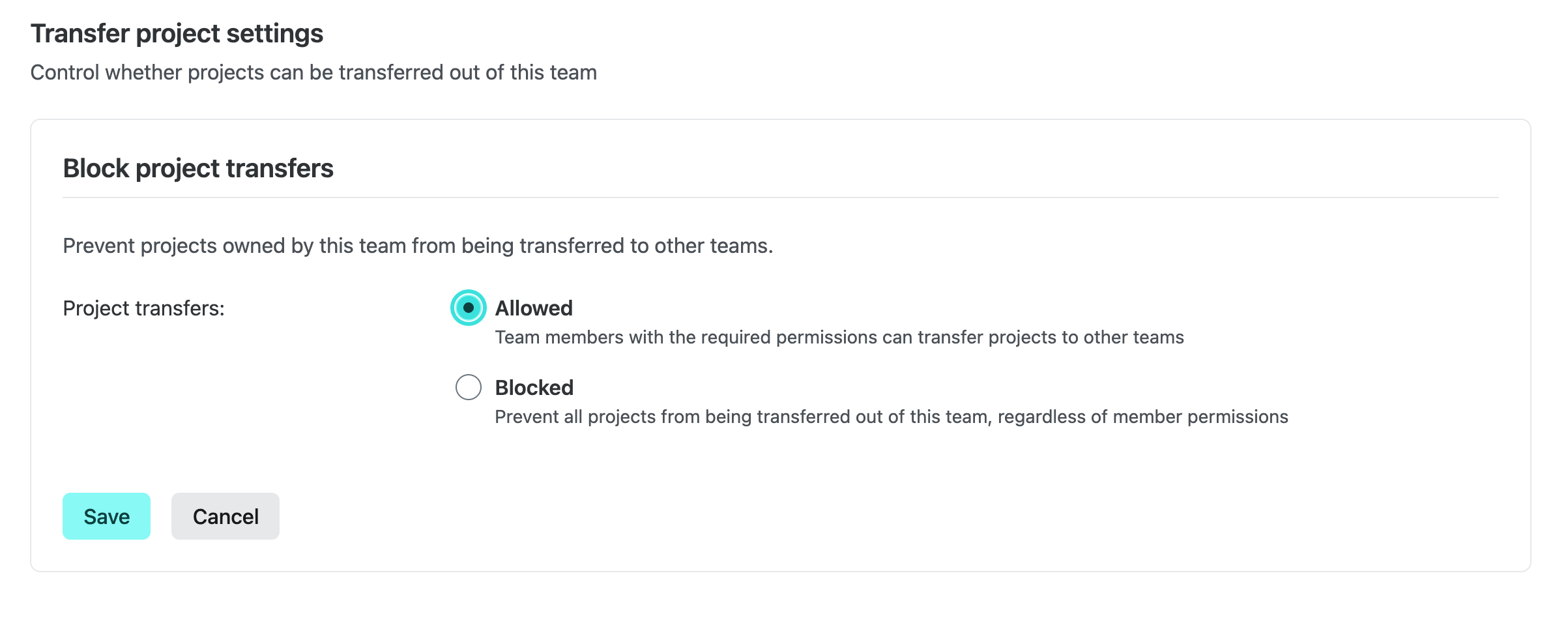
When transfers are blocked, the **Transfer project** action is hidden for every project owned by the team and the backend rejects transfer requests for those projects.
## Enterprise defaults
Enterprise teams start with project transfers set to **Blocked** for security reasons, but Team Owners can change this setting to **Allowed** at any time. Only Team Owners can change this setting and changes are recorded in the team audit log.
## Learn more
Learn more in our docs on [Transferring a project](https://docs.netlify.com/manage/accounts-and-billing/team-management/team-owned-sites/).
[Permalink to Block project transfers out of your team Permalink](/changelog/2026-05-08-block-project-transfers/)
[Next page](/changelog/tag/security/page/2)